Combining the analysis of spatial layouts with the study of social relations flourishing within different buildings for work (offices, hospitals, schools, universities, laboratories and so on) has been one of my core research interests for decades now, ever since the publication of my PhD on ‘The Space-Organisation Relationship’ back in 2010.
Both dimensions – spatial structures and social structures can be studied with related network methods: space syntax and social network analysis (SNA), but few people actually make the connection between those methods and theories.
Therefore, I was honoured having been invited to the Knitting Networks Podcast, produced by two wonderful SNA scholars, Francisa Ortiz Ruiz and Alejandro Espinosa Rada, who gave me an opportunity to talk about my work, the connections between social and spatial networks, how I found my way into the SNA community and what I am working on currently.
The full episode with my dialogue with Francisca in just over an hour was fun to do and contains a lot of my current thinking on social and spatial networks and how both approaches can be brought together fruitfully.
Here are some of the highlights from the conversation:
I introduce spatial network analysis (from 2:20 min) and the method and theory of space syntax (which features a lot here on my blog) as an approach that considers elements of space (for example rooms in a building) and how they are tied together (via doors and staircases) to form a network that can be investigated according to the centrality of spaces in the system and what this means for the emergence and distribution of behaviours such as movement or encounters. This frames “space as an antecedent to network creation” and social relations.
I talk about my ongoing and future work ideas (from 9:13 min) including:
- a project on elderly care facilities in China (from 10:13 min) together with my PhD student Xiaoming Li, considering the location of care homes and the opportunities for eldery people arising from the surrounding urban fabric as well as the interior layout of care homes to foster connections among visitors and inhabitants (as published in a book chapter in the 2022 edited book on ‘Social Networks and Social Resilience‘). We have by now published another paper together on the ‘Network of Co-Awareness’ in elderly care facilities, using visitor seats and nursing home beds as carriers of behaviour and linking them together by means of intervisibility to analyse different forms of emerging sociability.
- a paper on spatial routines (from 11:57 min) which ties sequences of tasks in hospital outpatient clinics into network structures, which showed that open-plan layouts housed more performative routines in comparison to traditional corridor and exam room layouts; this work explores the contribution of network methods to an understanding of bureaucratic organisations and has been published in the Journal Social Networks.
- an idea I have in mind for future research on hybrid work and networks over distances (from 18:34 min), asking the question what it means for our social relations and connectedness if offices are no longer the norm for where knowledge-intensive white-collar work takes place; this remains an idea at present although I have published a review of ‘The challenges of hybrid work: an architectural sociology perspective‘ in the journal Buildings & Cities in the meantime, which sketches some of the background and issues around this topic.
- a project on the duality of people and spaces (from 21:48 min) building on the groundbreaking work of Ron Breiger and aiming to understand space usage patterns or spatial practices, i.e., individuals frequenting certain spaces, or preferring one route from A to B such as one staircase over another. Preliminary findings from this line of work were presented at the Duality@50 conference in Switzerland in April 2024 and my keynote to the Space Syntax Symposium in July 2024.
We delve into what first got me interested in networks (from 26:50 min), where I tell the story of how I came across spatial networks in the form of the book ‘The Social Logic of Space‘ by Bill Hillier and Julienne Hanson during my PhD at the Technical University of Dresden and how this ultimately led me to London, where I learnt more about network methods and was co-supervised by Alan Penn in my PhD work. It was there that I also met the late Stephen Pryke, who introduced me to social network analysis and encouraged me to submit my first Sunbelt conference paper.
I reflect on my Sunbelt conference experiences (from 34:22 min) – the main annual conference of the social network community organised by INSNA (International Network of Social Network Analysis), including the funny anecdote (36:37 min) of how I found out what the Sunbelt ‘hospitality suite’ is.
The question of which researchers or which work inspires me (39:40 min) leads me again to both the spatial network dimension – clearly Julienne Hanson, my mentor when I first started working at UCL who gave me the wonderful advice to “duplicate myself” or her idea of the PhD as a network of topics – and the social network dimension, where I do name some people but mainly focus on the social networks community as a whole, which I find endlessly inspiring.
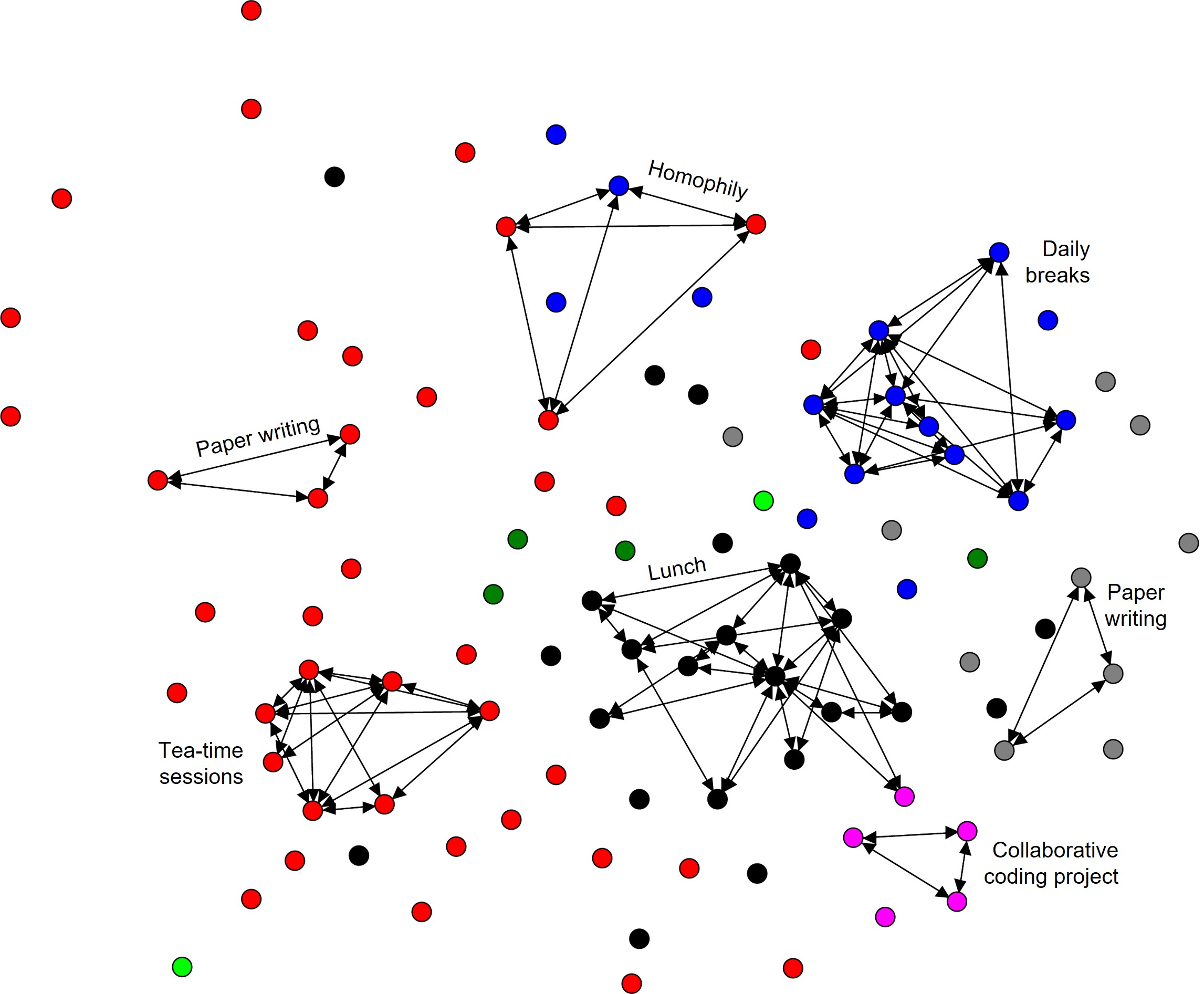
I even find a good answer to the complicated question for my favourite network (43:53 min), where I mention (among a few others) one of the first networks I researched myself as part of my PhD of a group of theoretical physicists in a research institute in Germany. The collaboration network, shown below, which I also use in my teaching highlights the clustering by research groups but also the importance of group cultures, organisational routines, homophily but also spatial practices (such as tea-time sessions or lunch meetings). It allows to read rationales for network formation in many layers.
And finally, Francesca asks me to reflect on future challenges for the field of social network analysis (49:19 min), where I express hopes for the spatial network community to learn more from the advanced modelling approaches of the social networks field but vice versa for the social networks community to learn from some of the perspectives we study in spatial networks (e.g., the comparative study of whole networks of different sizes). I also highlight how we should not discard networks collected with traditional methods (surveys, observations) in favour of technology-generated networks (e.g., sensor-based proximity networks).
If that has wet your appetite, go and listen to the full episode of Knitting Networks.
Since the podcast started in 2020, it features more than 70 episodes by now, interviewing amazing players of the social networks community – favourite episodes of mine include fascinating conversations with network eminence Mark Granovetter of ‘strength of weak ties’ fame, sociologist Mario Small and organisational network scholars David Krackhardt and Emmanuel Lazega. By always asking roughly the same set of questions the conversations give fantastic glimpses into people’s research approaches but also allows their personalities and stories to shine through. Highly recommended listening!
Ortiz Ruiz, F. (2023) ‘Knitting Networks 66: Kerstin Sailer’, Knitting Networks – Tejiendo Redes, Spotify [Podcast]. 26 Aug 2023. https://creators.spotify.com/pod/show/tejiendoredes/episodes/66-Kerstin-Sailer-e28i7qf (Accessed 16/01/2025).


 spaceandorganisation